
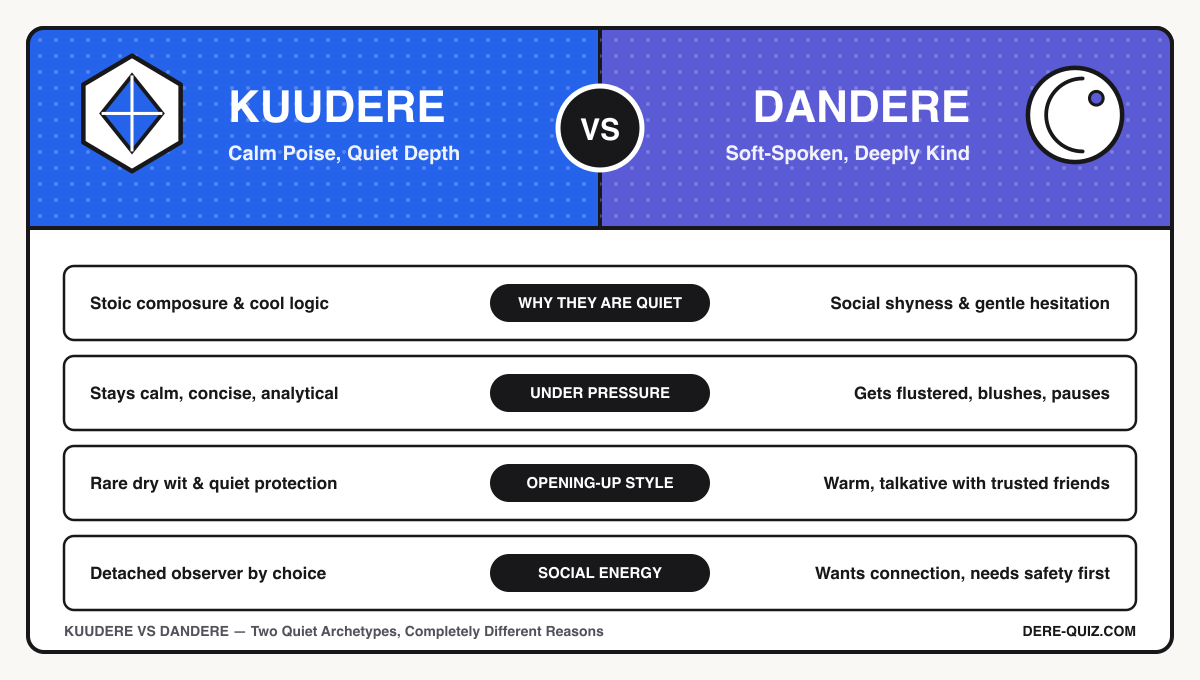
Side-by-Side Comparison Table
| Dimension | Kuudere | Dandere |
|---|---|---|
| Japanese Etymology | Kuuru (cool/composed) + Deredere (warm) | Danmari (silent/quiet) + Deredere (warm) |
| Reason for Silence | Calm temperament, efficiency, and emotional restraint | Shyness, social nervousness, or fear of interrupting |
| Under Sudden Spotlight | Answers concisely with an even tone and steady gaze | Blushes, pauses, and speaks softly before warming up |
| How They Open Up | Subtle dry humor, practical help, and rare gentle smiles | Becomes noticeably chatty, expressive, and affectionate |
| Group Role | Calm strategist, anchor, or deadpan voice of reason | Empathetic listener, thoughtful supporter, quiet creative |
| Common Misconception | Mistaken for cold or emotionless | Mistaken for timid or lacking opinions |
How Each Archetype Reacts in Everyday Scenarios
Scenario 1: Walking into a crowded club room full of strangers
Kuudere Response
Scans the room calmly, picks a clean seat near the wall, and observes who actually knows what they are doing.
Dandere Response
Hopes a familiar friend arrives soon, offers a polite shy nod, and waits for a gentle one-on-one chat.
Scenario 2: A group presentation slide deck crashes five minutes before start
Kuudere Response
Quietly pulls up the backup PDF, fixes the cable, and delivers the opening without raising their pulse.
Dandere Response
Feels a brief spike of nerves, then thoughtfully organizes the speaker notes so their partner feels supported.
Scenario 3: Talking about a favorite manga or game with a best friend
Kuudere Response
Delivers a deadpan, brilliantly structured analysis with two understated jokes that make their friend laugh.
Dandere Response
Lights up completely and talks happily for forty minutes straight, pulling out sketches and favorite panels.
Scenario 4: Realizing they accidentally took the wrong turn
Kuudere Response
Checks the map calmly, calculates the fastest detour, and walks there as if it were always Plan A.
Dandere Response
Apologizes warmly twice, blushes, and insists on buying their friend a snack to make up for the extra walk.
Why Quiet Introverts Score Differently on Each Archetype
On the surface, kuudere and dandere share plenty of traits: neither craves loud small talk, both notice details louder characters miss, and both reserve their truest selves for a trusted inner circle. Yet once you look under the hood, they represent two very different flavors of quiet personality.
- Kuudere is about composure. Their baseline state is cool, analytical, and self-contained. Even in high-pressure moments—like a crisis at school or a tense competition—their voice stays level. Their warmth feels like discovering a hidden fireplace inside a minimalist glass house.
- Dandere is about gentleness. Their quietness comes from sensitivity and shyness rather than stoic detachment. Once they know you are kind and patient, the hesitation melts away completely, revealing an expressive, deeply empathetic friend.
Where They Overlap With Other Dere Types
If you feel quiet around strangers and fiercely skeptical until trust is proven, you may also relate to mayadere. If you stay calm on the surface and enjoy dropping razor-sharp jokes that make your friends blush, check your sadodere score too. Take our 16-scenario Dere Type Quiz to see your exact split between Kuudere, Dandere, and all 8 other archetypes.
Common Questions: Kuudere vs Dandere
What is the fastest way to tell a kuudere from a dandere?
Watch how they react when suddenly called on in a room: a kuudere stays cool and concise, while a dandere gets flustered or apologetic.
Are dandere characters always introverts?
Nearly all dandere characters recharge in quiet spaces and prefer small circles, though many become lively and talkative around trusted friends.
Can someone have both kuudere and dandere scores on the quiz?
Yes! Many quiet anime fans score high in both—using kuudere calm at work or school while feeling dandere shyness in brand-new social settings.
Which archetype is warmer once you become close friends?
Both are deeply loyal. A dandere tends to become visibly bubbly and affectionate, while a kuudere expresses warmth through steady actions and understated dry wit.
Find out which side you lean toward
Take our 16-scenario Dere Type Quiz to compare your Kuudere and Dandere percentages directly.